

TL;DR
During COVID, governments replaced lost household income because the shutdown was visible and everyone agreed on what had happened. AI removes wages while offices stay open and output keeps rising, so nothing in the surface data triggers a response.
Corporate models assume productivity gains return to the economy through lower prices, but pass-through only works if consumers still have wages to spend. The same displacement also erodes the payroll base that funds the institutions expected to manage the transition.
The gap between displaced payroll and preserved purchasing power belongs to no one. Companies own margins, investors own returns, governments own budgets, and workers own the consequences. A gap nobody owns gets discovered late, in defaults and weak consumption rather than in policy.
During COVID we deliberately shut down large parts of the physical economy. Then governments kept demand alive by putting income directly into households and businesses. It was expensive and improvised and it mostly worked, because everyone could see what had happened. The storm was visible. The response was obvious.
AI runs the same problem in reverse. Offices stay open. Production continues. Quarterly numbers look fine. Nothing on the surface says anything is wrong. But underneath, wages can start leaving the system structurally, and no one calls it an emergency because nothing looks like one.
Rather than a sudden collapse, we are witnessing a slow drain on everyday purchasing power. The real danger of job loss isn't just vanished income. It is the systemic disappearance of the consumer base itself.
Where demand comes from
The economy runs on a loop that is almost embarrassingly simple. People earn income. They spend it. That spending becomes revenue for businesses, which pay wages again.
Think of it as a river-powered mill. The river is productive energy moving through the economy. The mill is the labour system that turns that energy into wages and purchasing power. The flour is what the rest of the economy eats.
For most of modern economic history, those flows stayed connected. Businesses became more productive, workers earned more, spent more, and supported further growth. When that balance holds, production and purchasing power reinforce each other. When it weakens, the damage rarely stays contained. It travels through hiring, investment, spending, and confidence.
AI changes the flow
Production can keep rising while less productive energy passes through the labour system. More of the river bypasses the mill entirely.
We have seen a version of this before.
Through the 1920s, American farmers adopted tractors, combines, and large-scale production methods. Agricultural productivity surged and surpluses piled up. But productive capacity grew faster than purchasing power. Crop prices collapsed, farmers could not service their debts, rural banks failed, and the stress moved outward into the financial system.
The problem was never a shortage of production. It was a weakening relationship between production and broad participation.
AI raises the possibility of the same imbalance across the knowledge economy, in a lot of sectors at once.
Most corporate models assume productivity gains eventually return to the economy through lower prices, higher consumption, or new demand. Economists call this pass-through. If AI makes a service dramatically cheaper, consumers should buy more of it or redirect the savings elsewhere.
There is a blind spot in that logic. Price reductions only stimulate demand if consumers still have purchasing power. If the savings on the corporate spreadsheet come from eliminating the customer’s income, the mechanism starts working against itself. Cheaper products matter very little to someone without wages to spend.
Each decision to automate stays locally rational. Collectively, the system starts behaving differently.
The river accelerates. Less of it reaches the mill.
The question markets have to answer
The obvious counterargument is that we have been here before and it turned out fine. Mechanisation, industrialisation, computers. Technology lowers prices, raises productivity, and creates work nobody could have described in advance.
Historically, that has largely been true.
But when agriculture mechanised, the shift from most people farming to almost nobody farming took about a century. Entire generations had time to adjust. Older farmers finished their careers while their children went into factories and offices. The economy changed, and human adaptation moved alongside it.
Software scales globally in months. Accounting, customer support, software development, legal analysis, marketing, and administration may all start changing at the same time.
The risk is not that new work never appears. It is that the retraining cycle may not keep pace with the deployment cycle. A 45-year-old analyst cannot step out of economic participation for a generation while the labour market reorganises. Housing, food, and consumption do not pause.
So pass-through depends on something deeper than lower prices. It depends on consumers still participating in the loop.
The issue is not whether AI expands productive capacity. It almost certainly will. The issue is whether purchasing power keeps circulating widely enough to absorb what gets produced.
The missing economic infrastructure
Modern economies were built on the assumption that productive activity and human payrolls stay connected. Governments fund social infrastructure through systems tied to wages: income taxes, payroll taxes, pension contributions, employment insurance, and the consumer spending of employed workers.
That works as long as the river keeps passing through the mill.
AI introduces a payroll logic failure. If productive capacity keeps growing while payroll participation weakens, the system starves the institutions expected to stabilise the transition. Displacement increases the demand for support and reduces the revenue that funds it at the same time.
This is where a different kind of mechanism becomes necessary. I call it the Agentic Economic Contribution, or AEC.
The AEC is not a robot tax and it is not a penalty for using AI. It is a transition mechanism tied to the economic effects of payroll displacement. When AI-driven productivity rises while human payroll falls, part of the displaced flow gets redirected back into the infrastructure that keeps demand alive.
To make this concrete, I built a simple demand-impact model. It does not try to predict the future of work. It isolates one mechanism: what happens to demand when payroll is displaced faster than purchasing power is replaced.
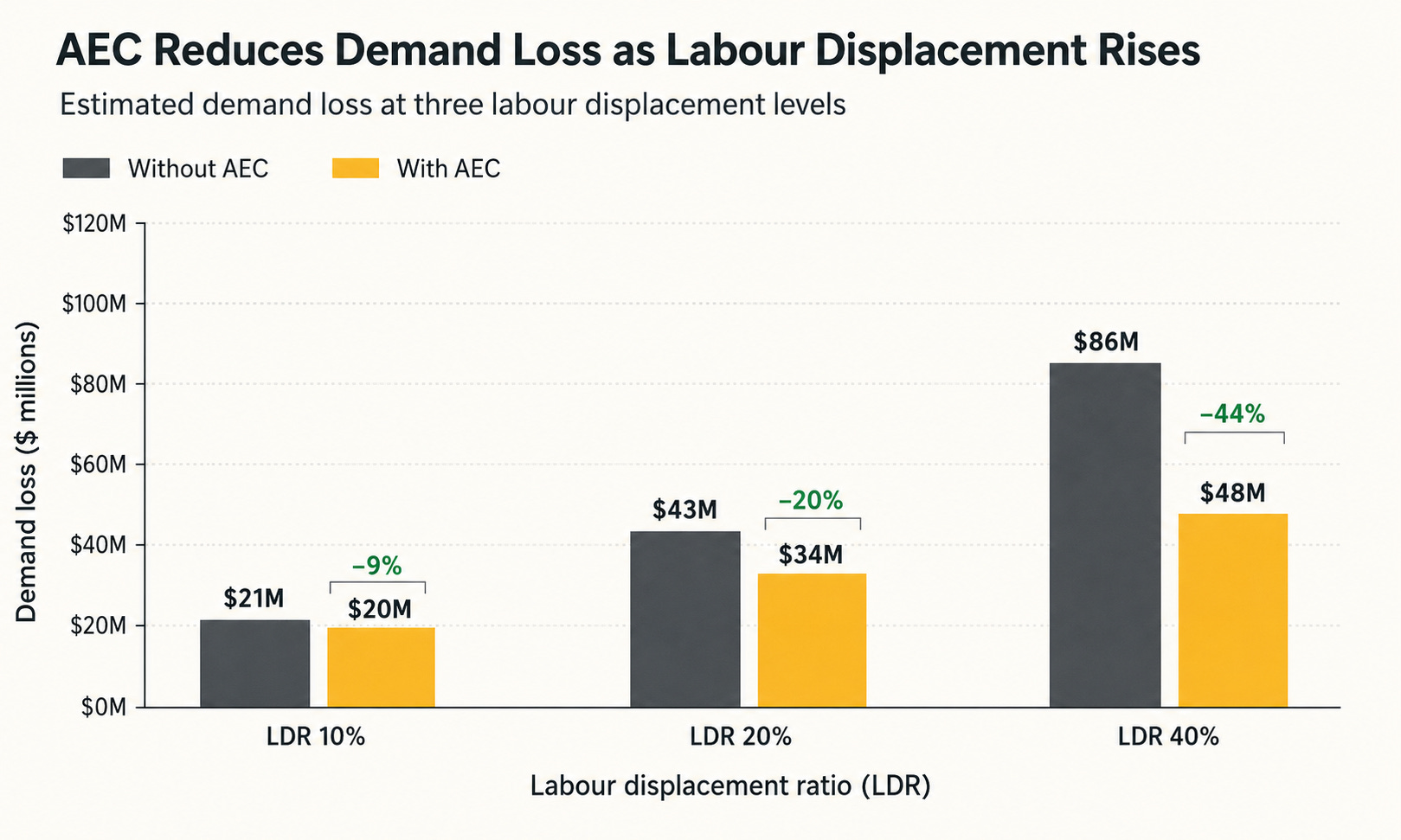
The model compares two scenarios. In the first, displaced payroll simply leaves the demand cycle. In the second, a modest AEC recirculates part of it.
The AEC does not solve the problem. Even in the model, most of the demand loss remains. What it does is slow the bleed while leaving most of the company’s incentive to adopt AI intact. The spreadsheet is available here for anyone who wants to change the assumptions, including displacement rate, spending rate, pass-through, contribution tiers, and multipliers.
The trigger would be the Labour Displacement Ratio, or LDR: the share of a company’s baseline payroll displaced by AI-attributed systems.
There is an obvious objection. How would anyone know whether payroll was displaced by AI rather than by a downturn, a restructuring, or a change in strategy?
That is what disclosure is for. In an earlier piece, Let AI Shovel the Snow, I argued that AI-driven displacement should begin with a standardised corporate disclosure form covering the function affected, the roles reduced, the system involved, and the estimated payroll value displaced. The point is not to track every software licence. It is to create an auditable record when AI materially reduces human roles, which becomes the empirical basis for the LDR.
A business saving a few hours a week stays below the threshold. Large institutional deployments become visible.
A company that displaces 3 percent of its payroll is not doing the same thing as one that displaces 40 percent. The first is having a productive year. The second is restructuring its relationship with the broader economy.
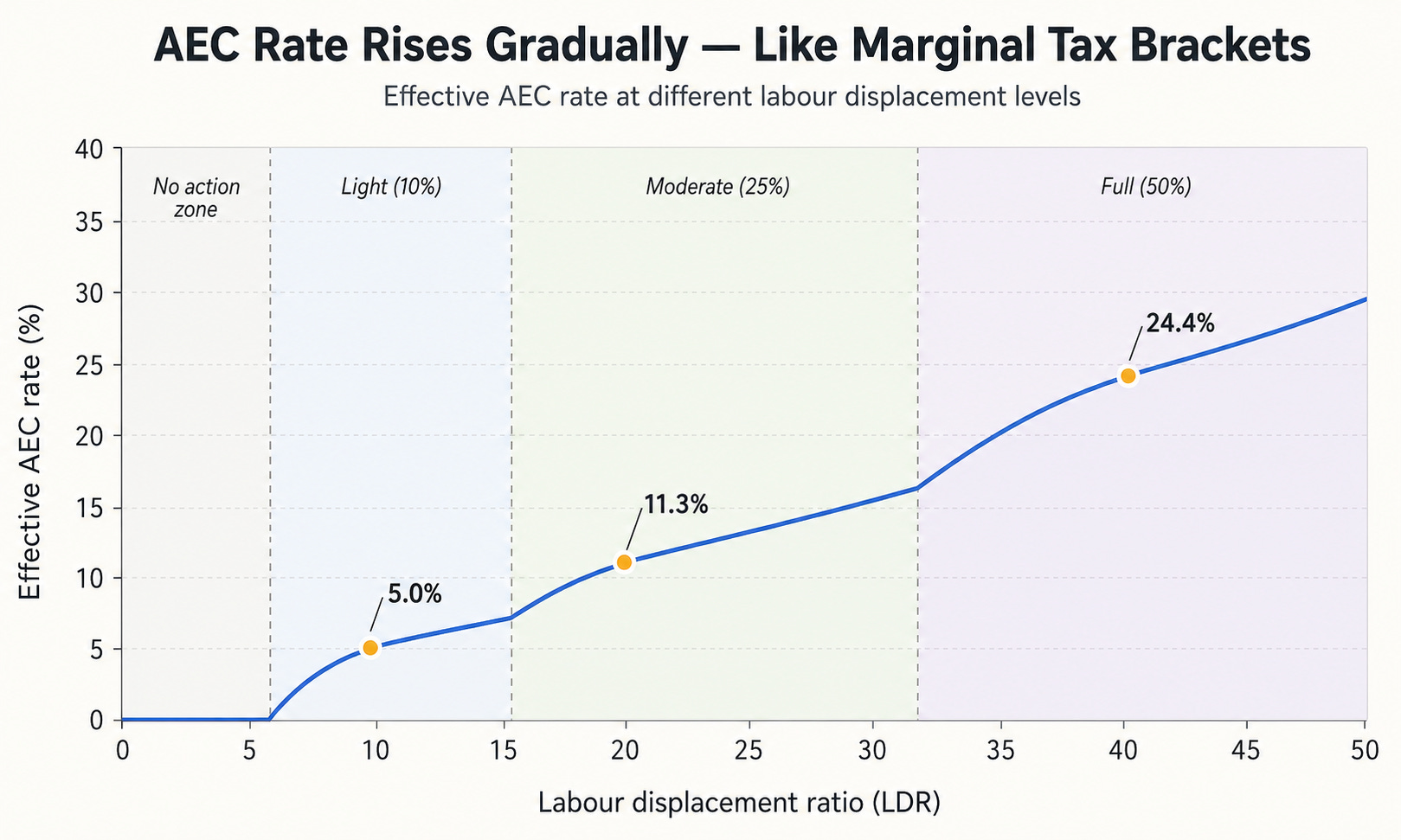
Rather than a flat penalty, the AEC would work like a set of sluice gates. As displacement rises, contribution rates open gradually. Small displacement triggers little or nothing. Larger displacement triggers more, but only on the portion above each threshold.
The logic is the same as marginal income tax. Crossing into a higher bracket does not tax everything at the top rate. Only the next layer is treated differently.
So a company displacing 12 percent of payroll faces something modest. At 40 percent it becomes meaningful, and it still keeps most of the savings. The framework has no cliff.
There is a jurisdictional problem too. If the mechanism applied only where AI servers physically sit, companies would move infrastructure into low-tax jurisdictions and keep selling into large consumer markets elsewhere.
That is why the AEC needs a dual nexus. The first is the activity nexus: where the automated productive activity occurs or is operationally controlled. The second is the consumer nexus: where the customers and economic beneficiaries are located. A company using AI infrastructure in one country to replace payroll in another while selling into a third would have obligations that follow the economic flow rather than the server rack.
The purpose is not perfect precision. No tax system has that. The purpose is to close the obvious loophole: automating globally while routing the economic activity through whichever jurisdiction asks for the least.
None of this requires treating AI as a person or as a corporation. It uses tools governments already run: marginal rates, payroll calculations, nexus rules. It just recognises that agentic systems now perform economically meaningful work, and that when that work displaces payroll at scale, the missing flow has to be accounted for somewhere.
Why companies would still adopt AI
The standard objection is that any contribution framework discourages innovation. That concern is fair. Designed badly, this becomes a drag on productivity instead of a stabiliser.
But the AEC is built around marginal displacement. Even at significant displacement levels, companies retain most of the financial benefit of adopting AI. The model shows a company displacing 40 percent of payroll still keeping the majority of its savings. The framework does not erase the incentive to automate. It prices part of the transition cost back into the decision.
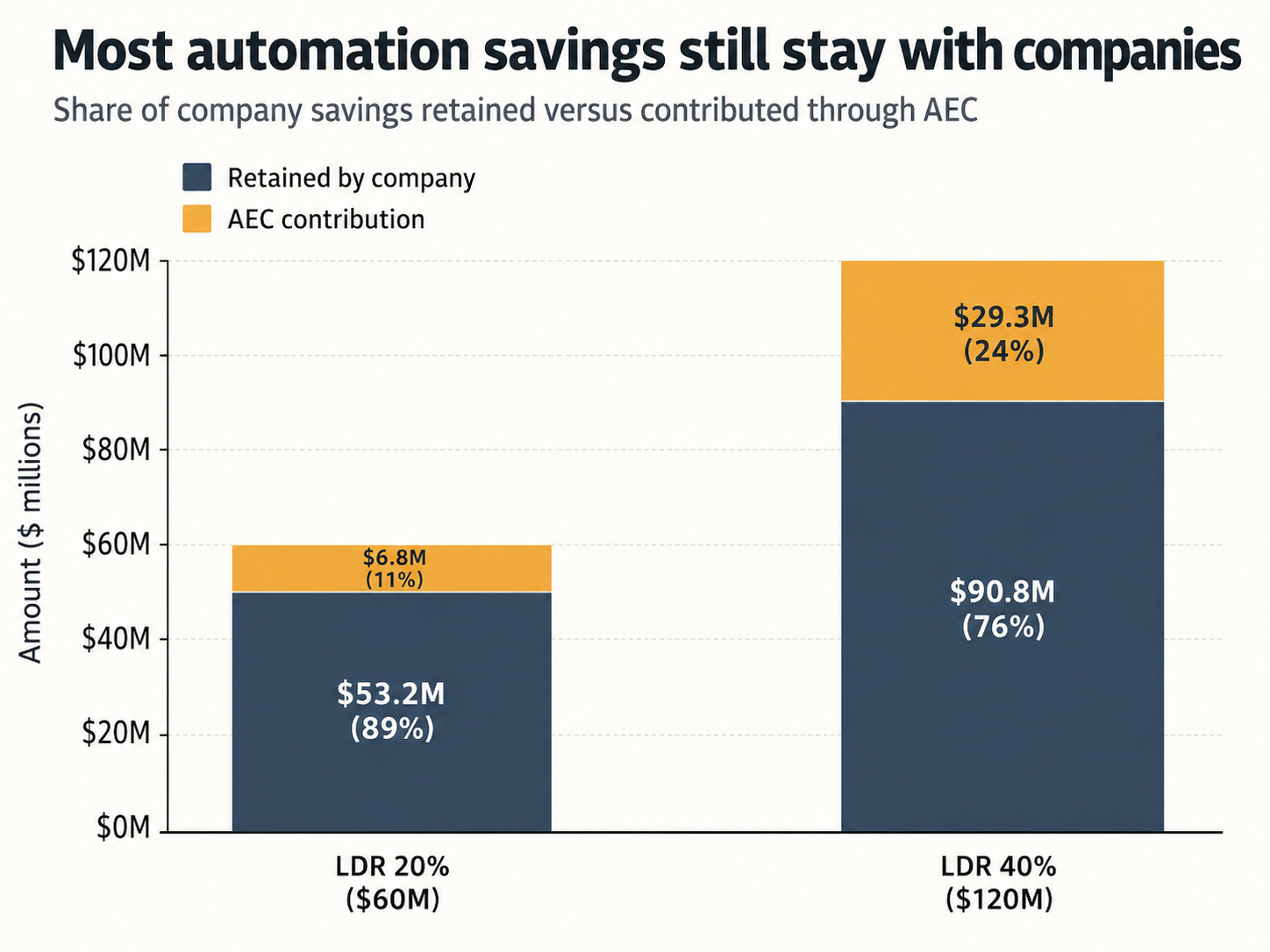
It might also change how automation gets evaluated internally. Without a contribution mechanism, the spreadsheet is simple. If AI can do the job cheaper, replacement wins. With a rising marginal contribution attached to large-scale displacement, full replacement starts competing against hybrid models where workers use AI to become far more productive.
In roles built on judgment, trust, accountability, or client relationships, that combination may already be the better option. The best use of AI is not always replacing people. Sometimes it is expanding what they can do.
A contribution framework would not force that choice. It would make it more honest. Replace at scale and you contribute to the transition costs you created. Use AI to keep people economically participating and you contribute less.
There is a reputational dimension as well. Consumers are already starting to distinguish between companies that use AI to extend human work and companies that use it to remove human contribution. The backlash against AI-generated art in games and media is an early version of this. People are not only asking whether AI was used. They are asking whether anyone was left in the process.
Environmental policy followed a similar arc. It started as compliance cost and became brand value, investor confidence, and consumer trust. AI may follow the same path, where firms get judged not on whether they use it but on how much participation they preserved.
The missing half of AI infrastructure
The imbalance is already visible in how governments are preparing.
Canada is funding expanded access to AI compute. The United Kingdom has invested heavily in national compute capacity through Isambard-AI and the AI Research Resource. France is positioning itself as a European infrastructure hub, with money flowing into sovereign compute, data centres, and firms like Mistral. The United States piloted the National AI Research Resource to widen researcher access to compute and data.
That investment may well be necessary. If AI becomes a major productive layer, it will need enormous physical infrastructure.
But almost all of the institutional energy is pointed at productive capacity. Very little is pointed at how societies maintain purchasing power, tax capacity, and participation if displacement accelerates.
We are building the rivers before we build the sluice gates.
This is not because companies are villains or governments are asleep. It is because every incentive currently points the same way. Companies are rewarded for efficiency. Investors reward margin expansion. Consultants are paid to help firms capture productivity gains. Governments want investment, data centres, energy projects, and technological standing.
Each of those makes sense on its own. Together they produce a one-sided tug of war. Nearly everyone is pulling toward more capacity and more speed. Far fewer institutions are pulling with equal force toward the systems needed if that deployment weakens the wage base demand depends on.
That is the missing half of AI infrastructure.
The visible half is easy to count. Servers, chips, power lines, announcements. The invisible half is harder: income continuity, retraining capacity, payroll replacement, demand stabilisation, and jurisdictional rules that stop displaced economic flow from vanishing into the least accountable channel.
Counting is where most of the conversation currently stops. A recent Atlantic cover story asked how soon AI would take American jobs, and the pattern in it was familiar. Economists, policymakers, labour leaders, and executives all agreed the risk was serious enough to discuss. The responses stayed mostly in the realm of measurement, retraining, wage insurance, shorter workweeks, or broad political aspiration.
Those conversations matter. But counting is not a response. It is the beginning of one.
No one owns the demand gap.
Companies own their margins. Investors own their returns. Governments own their budgets. Workers own the consequences. The space between displaced payroll and preserved purchasing power does not clearly belong to anyone, which is why it stays easy to ignore until it shows up in unemployment data, weaker consumption, defaults, or political anger.
The purpose of the AEC is to make that gap visible while it is still cheap to look at.
The real choice
This framework does not define the end state. It does not prescribe how governments should redistribute what gets captured, and it does not assume one model works across every jurisdiction and sector.
What it does is create the mechanism that makes informed choices possible.
Some governments may direct AEC flows toward retraining and workforce transition. Others may build public AI infrastructure that serves citizens directly. Others may choose income support or community stabilisation, or some combination that changes as the data improves.
The AEC does not dictate the answer. It creates the captured flow that lets answers emerge.
That is the minimum viable policy. Not a finished system. A starting point that generates the data, the revenue, and the institutional capacity to adapt as the transition unfolds.
Some economists argue it is too early to build systems around AI-driven displacement. They may turn out to be right.
But societies almost never build stabilising infrastructure after certainty arrives.
The question is not whether AI transforms the economy. That is already underway. The question is whether we build the gates before the pressure does the deciding for us.